
Five Early 2026 Mini PCs: Displays, Modularity, and High Performance
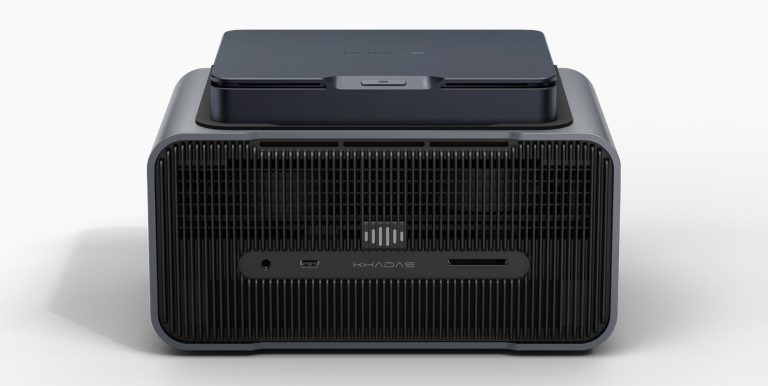
In early 2026, there were noticeably more devices in the mini PC segment that went beyond the usual format. This was not so much about a jump in raw performance as about attempts to rethink how a compact desktop computer could be assembled: add auxiliary displays, make connectivity modular, build in the power supply, or use mobile platforms without simplifying them. This roundup covers mini PCs shown at CES 2026 and immediately afterward that stand out for the developers’ unusual approach to design and capabilities.
AOOSTAR G-Flip — a mini PC with a flip-up touchscreen and Ryzen 7 255H
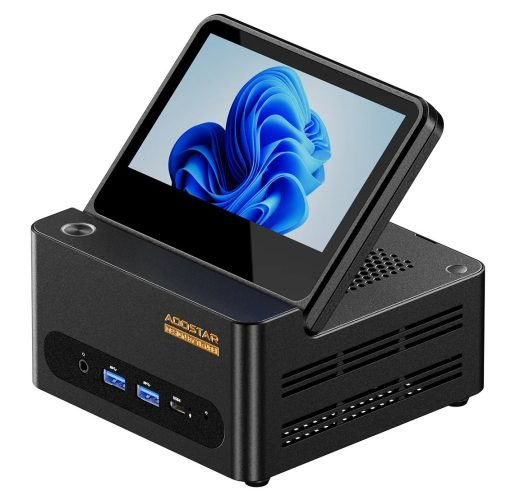
Here we have an unconventional mini PC that AOOSTAR has been developing for nearly a year, experimenting with both form factor and processor platforms. The version with the AMD RyzenTM 7 255H became the most affordable model in the lineup: it launched in early 2026 and is noticeably cheaper than earlier Strix Point and Core® Ultra versions.
The G-Flip’s defining feature is its small touchscreen, which flips up and becomes visible from the front. This is not a decorative element but a full-fledged Full HD display that can be used as a secondary screen. For example, it can show system monitoring data, notifications, media controls, or quick actions without having to power on the main monitor.
The new version is based on the AMD RyzenTM 7 255H from the Hawk Point generation. It is a close relative of the RyzenTM 7 8845HS, but without the NPU block for AI tasks. In raw CPU performance it posts similar synthetic benchmark results and looks like a good choice for users who do not need built-in AI acceleration but do care about price. At the same time, the mini PC remains expandable: inside there are two memory slots and two full-size M.2 slots for fast NVMe storage.
In its price category, the G-Flip competes with ordinary mini PCs that have no display at all, while offering additional functionality that may be useful in work scenarios, a home server, or as a compact desktop system.
Specifications:
- Processor: AMD RyzenTM 7 255H (Hawk Point)
- Graphics: integrated Radeon
- Memory: 2× SODIMM DDR5-5600, up to 128 GB
- Storage: 2× M.2 2280 PCIe 4.0 NVMe
- Display: 5-inch touchscreen, 1920×1080, 60 Hz, flip-up
- Ports: 1× OCuLink (PCIe 4.0 x4, up to 64 Gbps), 2× USB4 Type-C (40 Gbps), 2× USB 3.2 Gen 2 Type-A, 2× USB 2.0 Type-A, 2× 2.5GbE Ethernet, 1× HDMI 2.1, 1× 3.5 mm audio, power jack
- Wireless: Wi‑Fi 6, Bluetooth 5.2
- Cooling: active, with fans and a vapor chamber
The model went on sale in January 2026. The base version without memory and storage is priced from about $339–$350, depending on the store and configuration.
Khadas Mind Pro — a pocket-sized mini PC with Panther Lake and a modular focus

This is a new generation of ultra-compact mini PCs from Khadas, shown at CES 2026 and aimed squarely at the upper segment right away. With dimensions of just 146 × 105 × 28 mm, the device is internally closer to a high-performance laptop than to a conventional mini PC. It is built around Intel Panther Lake mobile processors with powerful integrated Arc Pro graphics, while the key feature remains the proprietary Mind Link interface, which allows external modules to be connected, from docks to eGPUs and portable displays.
Unlike most mini PCs, the Mind Pro was designed from the start as part of an ecosystem. The computer itself is a basic compute module that can be used as a desktop system, carried in a bag, or connected to additional accessories. At about 560 g, it is lighter than almost any laptop, and its built-in battery makes it possible to move the device safely between workspaces without shutting it down and to survive short power interruptions without data loss.
At launch only one configuration is available, but Khadas has outlined plans to expand the lineup. Notably, the company chose to prioritize stronger integrated graphics even at the cost of reduced bandwidth for external GPUs. That makes the mini PC more self-sufficient without mandatory eGPU use.
Specifications:
- Processor: Intel® Core® Ultra X7 358H (Panther Lake)
- Graphics: Intel Arc B390 Pro (integrated, 12 cores)
- Memory: 64 GB LPDDR5x-8533 in the launch version
- Storage: 2 TB PCIe 4.0 NVMe SSD (M.2 2230)
- Expansion interface: Mind Link (PCIe 5.0 x4)
- Ports: 2× Thunderbolt 4, 2× USB 3.2 Gen 2 Type-A, 1× HDMI 2.1
- Wireless: Wi‑Fi 7, Bluetooth 6
- Power: 100 W USB-C power adapter
- Cooling: active, with a fan and vapor chamber
- Built-in battery: 7.98 Wh (up to 48 hours of standby)
- Chassis volume: 0.43 l
- Weight: about 562 g
Khadas Mind Pro has been available for preorder since January 2026. The launch configuration with the Core Ultra X7 358H, 64 GB of memory, and a 2 TB SSD is offered at $1,799, after which the retail price is expected to rise to $1,999 once the preorder window closes.
MINISFORUM M2 Pro — a mini PC with Panther Lake, a built-in power supply, and LPDDR5X-9600
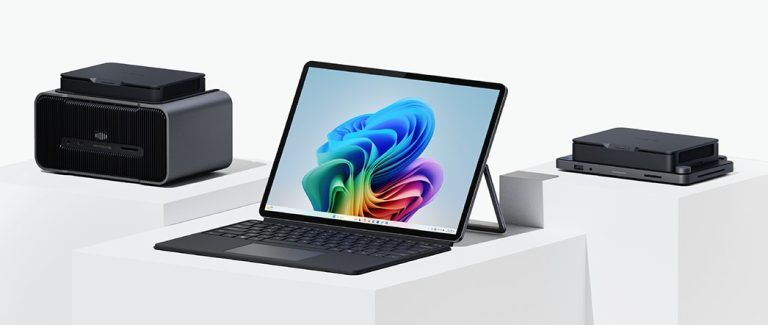
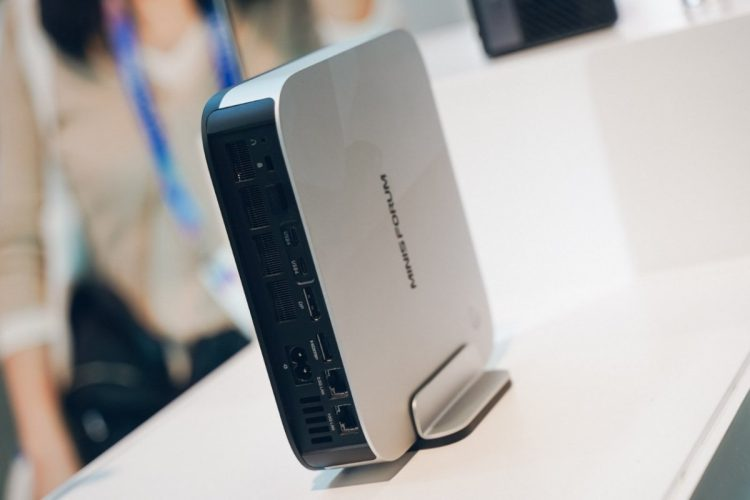
This is a mini PC that the company showed at CES 2026. It is designed around Intel Panther Lake mobile processors up to the Core® Ultra X9 388H. It stands out from its peers by including several solutions that are unusual for mini PCs. The main one is the built-in power supply: the computer plugs directly into a wall outlet with a standard cable, without an external power brick. It is a small detail, but a nice one.
In terms of internals, the M2 Pro is closer to premium laptops than to classic desktop “boxes.” It uses soldered LPDDR5X memory clocked as high as 9600 MT/s in capacities up to 96 GB, while graphics duties are handled by the integrated Intel Arc B390. That combination is meant for workloads where high memory bandwidth and compactness matter more than future upgradability.
The port selection on the M2 Pro looks impressive for such a small machine: several USB4 ports, video outputs, and two network interfaces, 10GbE and 2.5GbE. OCuLink remains a question mark: it is mentioned in descriptions, but the connector cannot be seen in the published photos.
Specifications:
- Processor: up to Intel® Core® Ultra X9 388H (Panther Lake)
- Graphics: integrated Intel Arc B390
- Memory: LPDDR5X-9600, up to 96 GB
- Ports: 3× USB4, 2–3× USB Type-A, HDMI, DisplayPort, 10GbE and 2.5GbE Ethernet, 3.5 mm audio
- Power: built-in power supply
- Extras: Copilot button, likely fingerprint reader, microphones
As of late January, the company had not yet announced either pricing or a shipping date.
Machenike GTS — a mini PC with a flip-up display and Arrow Lake-H
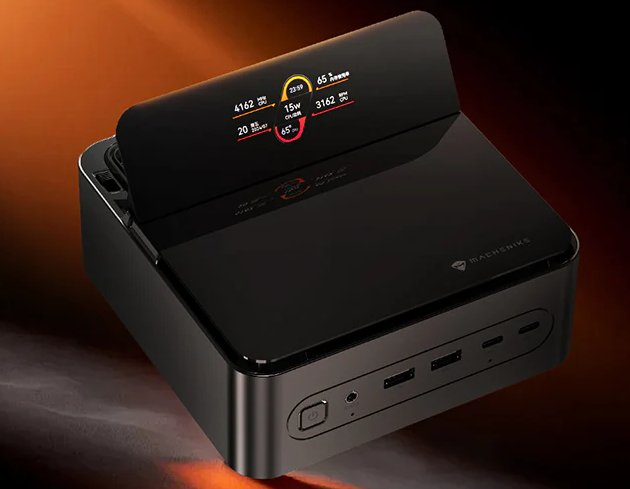
The main feature of this device is a 2.33-inch LCD built into the top cover and mounted on a hinge. The screen is too small for working with an interface or apps, but it is well suited to displaying service information. Machenike offers proprietary “smart screen” software that can show CPU, graphics, memory, temperature, and power-consumption data. This is not a unique capability, but rather a niche solution for people who want to see system status without launching utilities on the main monitor.
Overall, the Machenike GTS is an ordinary high-performance mini PC in a metal chassis measuring 147 × 147 × 61 mm. Inside are Intel Arrow Lake-H mobile processors up to the Core® Ultra 9 285H, two memory slots, and two full-size M.2 storage slots. In terms of components, it is closer to a compact workstation than to an office box, and the cooling system is designed for sustained operation under heavy load.
Specifications:
- Processor: up to Intel® Core® Ultra 9 285H (Arrow Lake-H, 16 cores)
- Graphics: integrated Intel Arc
- Memory: 2× SODIMM DDR5-5600, up to 128 GB
- Storage: 2× M.2 2280 PCIe 4.0 NVMe
- Display: 2.33-inch flip-up LCD for system status information
- Ports: 2× USB4 Type-C (40 Gbps), 1× USB 3.2 Gen 2 Type-C (10 Gbps), 4× USB 3.2 Gen 1 Type-A, 2× 2.5GbE Ethernet, 1× HDMI 2.0, 1× DisplayPort 1.4, 1× 3.5 mm audio, power jack
- Wireless: Wi‑Fi 6E, Bluetooth 5.3
- Cooling: active, with four fans and two heat pipes
- Power draw: up to 65 W sustained, up to 70 W short-term
- Chassis: metal, 147 × 147 × 61 mm
The Machenike GTS went on sale in early 2026. In China, base configurations with the Core® Ultra 5 225H and 32 GB of memory are priced from about $800. Outside China, the device is noticeably more expensive: versions with the Core® Ultra 9 285H and 64 GB of memory are offered at around $1,800.
MINISFORUM AI X1 Pro-470 — an updated mini PC with Ryzen AI 9 HX 470
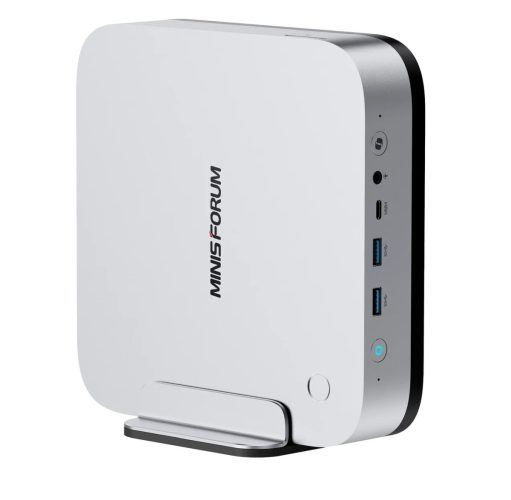
This is one of the most versatile mini PCs in the MINISFORUM lineup. It now comes with the new RyzenTM AI 9 HX 470 processor from the Gorgon Point generation. Externally and structurally it is the same chassis as the 2025 model, but with small performance and AI-related changes.
Like the previous version, the AI X1 Pro is aimed at users who need a compact but highly expandable desktop PC. The device supports up to 96 GB of memory, several NVMe drives at once, output to multiple displays, and connection of an external graphics card via OCuLink.
Architecturally, the RyzenTM AI 9 HX 470 is close to the RyzenTM AI 9 HX 370: the same 12 cores and 24 threads using a mix of Zen 5 and Zen 5c, and the same Radeon 890M integrated graphics with 16 RDNA 3.5 compute units. The main differences are slightly higher clocks and an updated NPU that delivers up to 55 TOPS of AI performance instead of 50 TOPS in the previous version. In total, MINISFORUM claims up to 86 TOPS when the CPU, GPU, and NPU are used together.
The metal chassis, built-in power supply, fingerprint scanner, stereo speakers and microphones, SD card slot, and modern ports make the device a convenient option for developers, content creators, and similar users.
Specifications:
- Processor: AMD RyzenTM AI 9 HX 470 (Gorgon Point, 12 cores / 24 threads)
- Graphics: Radeon 890M (16 RDNA 3.5 compute units)
- NPU: up to 55 TOPS
- Memory: DDR5, up to 96 GB
- Storage: up to 3× PCIe 4.0 NVMe SSD
- Video outputs: support for up to 4 displays
- Interfaces: OCuLink for an external GPU, 2× USB4 (40 Gbps), USB Type-A, DisplayPort, HDMI, SD card reader, audio jack
- Networking: Wi‑Fi 7, Bluetooth 5.4, 2× 2.5GbE Ethernet
- Chassis: metal, with a built-in power supply
- Extras: fingerprint scanner, stereo speakers, dual microphones, Copilot button
As of late January 2026, the MINISFORUM AI X1 Pro-470 is available for preorder. The base version without memory and storage is priced at about $760. A configuration with 32 GB of memory and a 1 TB SSD is significantly more expensive at around $1,360. Shipping is scheduled to begin on February 10, 2026, so there is not long to wait.
Which mini PC in this roundup did you like most, and why? If none of them stood out, maybe you can suggest one of your own.